 TCR Media November 11, 2025
In the field of material analysis, Tensile Testing and Metallurgical Testing are two of the most important methods used to ensure the strength, reliability, and performance of materials. These tests are part of Material Testing, which helps industries verify that metals and alloys meet required quality standards before being used in production. Tensile Testing focuses on measuring how a material reacts when stretched or pulled, while Metallurgical Testing studies the internal structure and composition of the material. Together, they provide a complete understanding of a material’s behavior and durability.
What is Material Testing?
Material Testing is the process of examining the physical, chemical, and mechanical properties of materials to confirm their suitability for specific applications. It ensures that materials can perform safely and efficiently under various working conditions.
This testing is essential in industries like automotive, aerospace, construction, oil and gas, power, and manufacturing, where material failure can lead to costly downtime or safety risks.
Material Testing includes several methods, such as:
- Tensile Testing (mechanical test)
- Metallurgical Testing (structural test)
- Hardness Testing
- Impact Testing
- Chemical Composition Testing
Among these, Tensile and Metallurgical Testing are considered the most fundamental and complementary techniques.
Tensile Testing
Tensile Testing, also known as tension testing, is a mechanical test used to measure how a material behaves when a pulling force is applied until it breaks. This test determines important mechanical properties such as strength, ductility, and elasticity.
It helps manufacturers understand whether a material is strong enough to handle real-world stresses like stretching, bending, or pressure.
Purpose of Tensile Testing
The main goal of Tensile Testing is to find out:
- How much force a material can withstand before breaking.
- How much it can stretch (ductility).
- How it behaves when subjected to stress and strain.
This information helps engineers design components that are strong, safe, and durable.
Process of Tensile Testing
- A sample (usually a small metal rod or sheet) is prepared according to a standard size.
- The specimen is placed in a Universal Testing Machine (UTM).
- The machine applies a pulling force gradually until the sample breaks.
- During the test, data such as load, elongation, and breaking point are recorded.
- A stress-strain curve is generated to show how the material behaved during the test.
Key Properties Measured
- Ultimate Tensile Strength (UTS): Maximum stress before breaking.
- Yield Strength: The point where permanent deformation begins.
- Elongation (%): The percentage increase in length before fracture.
- Modulus of Elasticity (Young’s Modulus): Stiffness of the material.
- Reduction in Area: Indicates ductility.
Importance in Industry
Tensile Testing is widely used in:
- Metal manufacturing
- Automotive component design
- Aerospace structures
- Construction materials
- Welding joint evaluation
It ensures that materials meet safety and design standards before being used in production.
Metallurgical Testing
Metallurgical Testing is the examination of metals and alloys to study their internal structure, grain pattern, and composition. It helps determine the reasons behind material behavior, strength, and performance.
While Tensile Testing shows how a material behaves, Metallurgical Testing explains why it behaves that way.
Purpose of Metallurgical Testing
The objective of Metallurgical Testing is to:
- Understand the microstructure of metals.
- Detect defects, inclusions, or impurities.
- Examine heat treatment effects.
- Investigate material failures.
- Verify compliance with metal grade and standards.
Types of Metallurgical Tests
1. Macro Examination: The metal surface is visually inspected for defects such as cracks, weld flaws, or porosity.
2. Microstructure Examination (Metallography):
A small polished and etched sample is viewed under a metallurgical microscope to observe:
- Grain size and shape
- Phase distribution
- Inclusion content
- Structural defects
This helps determine if the material has been properly processed.
3. Hardness Testing:
This test measures a material’s resistance to indentation. Common methods include:
- Rockwell Hardness Test
- Brinell Hardness Test
- Vickers Hardness Test
Hardness gives an idea of a material’s strength and wear resistance.
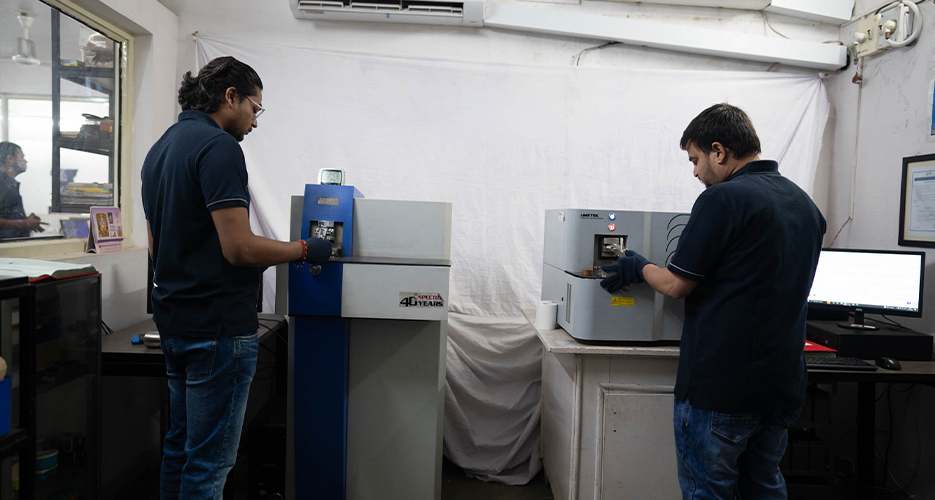
4. Chemical Composition Analysis: Spectrometers like OES (Optical Emission Spectroscopy) or XRF (X-ray Fluorescence) are used to analyze the percentage of alloying elements and impurities.
5. Failure Analysis: When a material fails during service, Metallurgical Testing helps identify the root cause — whether it’s due to fatigue, corrosion, poor heat treatment, or manufacturing defects.
6. Grain Size and Structure Analysis: The grain structure of a metal affects its strength and toughness. Fine grains usually provide better mechanical performance.
Common Equipment Used
- Metallurgical Microscope
- Scanning Electron Microscope (SEM)
- Spectrometer (OES / XRF)
- Microhardness Tester
- Sample Polishing & Etching Machines
- Image Analysis Software
Explore Full Metallurgical Testing Process
1. Microstructure Examination
Microstructure Examination is a key step in understanding how a metal behaves. Every metal contains tiny features like grains, phases, and inclusions that directly affect its strength, hardness, flexibility, and durability. By using a microscope, we can study these internal patterns and identify any defects or irregularities. This test helps engineers decide whether a material is suitable for a specific application or if any heat treatment is required. Overall, it gives a deep insight into the true quality of a metal.
2. Macrostructure Examination
Macrostructure Examination focuses on the larger features of a material that can be seen with the naked eye or low magnification. It helps us identify bigger defects such as cracks, porosity, shrinkage, seams, and weld issues. This test is usually done after polishing or deep etching the sample to reveal its internal structure. It is extremely helpful for evaluating castings, forgings, and welded components. By understanding these larger flaws early, industries can avoid failures and ensure better quality control.
3. Linear Measurement on Weld
Linear Measurement on Weld is used to check the accuracy, alignment, and overall size of weld joints. It ensures that the weld bead height, width, and length are within the required specifications. This measurement is important because even small dimensional errors in welds can lead to stress concentration and mechanical failure later. By measuring the weld properly, companies can confirm the workmanship quality, maintain safety standards, and avoid rework. It is a simple yet crucial part of welding inspection.
4. Grain Size Measurement
Grain Size Measurement helps determine the average size of grains inside a metal. Grain size plays a major role in deciding how strong or tough the material will be. Smaller grains usually increase strength, while larger grains improve ductility. This test is performed using microscopic images and standardized comparison charts. It is commonly used in heat treatment evaluation, quality control, and failure analysis. Understanding the grain size ensures that the material meets the required mechanical properties for its application.
5. Inclusion Rating
Inclusion Rating evaluates the amount and type of non-metallic particles present inside steel or other metals. These inclusions come from manufacturing processes and can affect the material’s performance. Too many inclusions can reduce strength, toughness, and fatigue life. By rating inclusions using standardized charts, engineers can understand the cleanliness level of the material. This test is especially important in critical applications like aerospace, automotive, and pressure vessels where high-quality steel is required for safety and durability.
6. Jominy End Quench Test
The Jominy End Quench Test is used to measure the hardenability of steel. A heated steel sample is quenched at one end, and the hardness is measured along its length. This shows how deep hardness can penetrate into the material during heat treatment. It helps determine the best cooling method and suitable alloy composition for achieving desired mechanical properties. Industries use this test to select the right steel grade for gears, shafts, and heavy-duty components that require consistent hardness.
7. Case Depth Measurement
Case Depth Measurement determines the thickness of the hardened layer on the surface of a material after processes like carburizing, nitriding, or induction hardening. The depth of this hardened layer is very important for components that need both surface hardness and core toughness. If the case depth is too shallow, the part may wear out quickly; if too deep, it may become brittle. This test ensures that the heat treatment process is effective and matches the required specifications.
8. Nitriding / Coating Layer Measurement
Nitriding or Coating Layer Measurement focuses on checking the thickness and quality of surface-enhanced layers formed by chemical or thermal treatments. These layers improve wear resistance, reduce friction, and increase corrosion protection. Measuring their thickness helps confirm whether the treatment was successful and uniform. This is especially important for tools, dies, engine parts, and high-performance components. A properly measured nitriding or coating layer ensures long-lasting performance and reduces the chances of premature failure.
9. Measurement (General Metallurgical Measurement)
General Metallurgical Measurement covers different dimensional and structural evaluations performed on metals to assess their quality. This may include layer thickness, defect size, crack length, weld dimensions, and heat-affected zone measurements. These measurements are essential for understanding how a material will perform under stress or load. Accurate data helps engineers maintain product consistency, meet quality standards, and prevent operational failures. Such measurements play a vital role in industries where precision and safety are top priorities.
10. Color Metallography
Color Metallography is a special technique used to differentiate various phases and microstructural features by applying chemical etchants that produce colorful patterns. Unlike standard black-and-white microscopy, this method helps identify grain boundaries, precipitates, and phase distributions more clearly. It is particularly useful for analyzing stainless steel, high-strength alloys, and heat-treated materials. This technique provides deeper insight into the material’s microstructure, helping engineers make better decisions about heat treatment, material selection, and quality control.
11. Sigma Phase Measurement
Sigma Phase Measurement involves identifying and measuring the presence of sigma phase, which is a hard and brittle intermetallic compound often found in stainless steels. Excess sigma phase can reduce toughness, corrosion resistance, and overall performance. This test helps determine whether the material has been exposed to high temperatures for too long or processed incorrectly. By examining and measuring sigma phase, engineers can prevent failures, improve heat treatment processes, and ensure the material performs reliably in demanding environments.
12. Retained Austenite
Retained Austenite measurement checks how much austenite remains in steel after heat treatment. Too much retained austenite can cause dimensional instability, reduced hardness, and unpredictable performance during service. This test is commonly used for carburized, quenched, and tempered parts. By understanding the percentage of retained austenite, heat treatment processes can be optimized for consistent results. It helps ensure that components such as gears, bearings, and tools achieve the required strength and durability.
13. Micro Hardness
Micro Hardness Testing measures the hardness of very small and specific areas on a metal surface. It is useful for evaluating thin layers, coatings, heat-affected zones, and microstructural features. The test uses a tiny indenter and low force, making it ideal for precise hardness mapping. Micro hardness results help understand variations in material properties at different points, ensuring uniform quality. This test is especially valuable in heat treatment validation, coating assessment, and failure analysis.
Difference Between Tensile and Metallurgical Testing
1. Type
Tensile Testing: Mechanical Test
Metallurgical Testing: Structural & Chemical Test
2. Purpose
Tensile Testing: Measures strength and ductility
Metallurgical Testing: Studies internal grain structure
3. Result
Tensile Testing: Numerical (strength, elongation)
Metallurgical Testing: Visual and analytical (micrographs, composition)
4. Nature
Tensile Testing: Destructive
Metallurgical Testing: Non-destructive / micro-level
4. Outcome
Tensile Testing: How the material performs
Metallurgical Testing: Why the material performs that way
For example, if a steel sample shows low tensile strength, Metallurgical Testing can reveal that the grain structure is coarse or that impurities are present — explaining the failure.
Industrial Applications
Automotive Industry
Used for testing metal sheets, fasteners, engine parts, and welded joints. Ensures vehicle components can handle mechanical loads safely.
Aerospace Sector
Validates high-strength alloys used in aircraft frames, engines, and landing gears. Metallurgical analysis ensures structural integrity after heat treatment.
Oil & Gas Industry
Evaluates pipelines, pressure vessels, and drilling tools. Identifies issues like corrosion, cracking, or improper heat treatment.
Construction and Infrastructure
Ensures the reliability of structural steel, reinforcement bars, and welded sections used in bridges and buildings.
Manufacturing and Foundries
Monitors casting quality and alloy uniformity to maintain consistency and prevent premature failures.
Why Both Tests are Important Together
Tensile Testing and Metallurgical Testing complement each other.
- Tensile Testing provides mechanical data like strength and ductility.
- Metallurgical Testing provides structural insights that explain those results.
When used together, they offer a complete evaluation — helping engineers:
- Predict performance under real conditions.
- Detect defects before component failure.
- Improve manufacturing and heat treatment processes.
- Ensure compliance with ASTM, ISO, and BIS standards.
Benefits for Industries
- Improved Product Quality: Detects material defects early.
- Enhanced Reliability: Ensures strength and consistency.
- Failure Prevention: Identifies weaknesses before use.
- Cost Efficiency: Reduces rework and replacements.
- Compliance: Meets required national and international standards.
About TCR Advanced Engineering PVT. LTD.
TCR Advanced Engineering PVT. LTD. is a trusted and leading name in the field of Tensile Testing and Metallurgical Testing services. With Modern laboratory equipment and a team of skilled professionals, TCR delivers highly accurate, reliable, and standard-compliant material testing results. The company specializes in evaluating material strength, ductility, and structural integrity across a wide range of industries. From tensile testing of metals and alloys to detailed metallurgical examinations, TCR ensures that every result meets global quality and safety benchmarks. With years of expertise and commitment to excellence, TCR Advanced Engineering PVT. LTD. helps clients achieve consistent performance, long-term reliability, and complete confidence in their materials.
Conclusion
In modern engineering and manufacturing, Tensile Testing and Metallurgical Testing play a crucial role in ensuring the strength, safety, and reliability of materials. TCR Advanced Engineering PVT. LTD. provides world-class testing solutions supported by advanced technology and expert analysis. Tensile Testing measures a material’s performance under load, while Metallurgical Testing reveals its internal structure and composition — together offering a complete picture of material quality. By partnering with TCR Advanced Engineering PVT. LTD., industries gain access to precise, accredited testing services that help prevent failures, maintain compliance, and ensure the highest level of product quality and performance.
FAQs
1. What is Tensile Testing?
Tensile Testing is a process used to check how strong a material is by stretching it until it breaks to measure its strength and flexibility.
2. Why is Tensile Testing important in industries?
Tensile Testing helps industries ensure that materials used in products like steel, alloys, or plastic parts are safe, durable, and meet required performance standards.
3. What does Metallurgical Testing mean?
Metallurgical Testing is the study of metals’ internal structure, composition, and grain pattern to understand their quality, defects, and overall material behavior.
4. How are Tensile and Metallurgical Testing different?
Tensile Testing measures the mechanical strength of a material, while Metallurgical Testing focuses on its internal structure, chemical composition, and grain formation.
5. What information do we get from Tensile Testing?
Tensile Testing provides data about a material’s tensile strength, yield strength, elongation, and elasticity, helping engineers design safe and reliable components.
6. Why is Metallurgical Testing necessary after mechanical tests?
Metallurgical Testing explains the reasons behind mechanical results by revealing defects, impurities, or improper heat treatment within the metal’s internal structure.
7. What industries use Tensile and Metallurgical Testing?
These tests are widely used in industries like automotive, aerospace, oil and gas, construction, and manufacturing to ensure high-quality, reliable materials and parts.
8. What equipment is used in Tensile Testing?
Tensile Testing uses a Universal Testing Machine, load cell, and extensometer to apply tension and measure how much force a material can handle before breaking.
9. What does a Metallurgical Microscope show?
A Metallurgical Microscope helps visualize the metal’s microstructure, showing grain size, shape, and any inclusions or defects that affect material strength and durability.
10. How do both tests help in quality control?
Tensile Testing confirms the material’s mechanical performance, while Metallurgical Testing ensures structural integrity, together providing a complete picture of quality assurance.